
Building a Website: Lessons Learned and Tips for Success
Creating a website can be a pretty intimidating concept for most people. There are so many things that go into it, that it’s totally normal to feel overwhelmed by the process. When I began building this website, I knew that it needed to be about more than just my online presence, I wanted it to effectively serve as a tool for people looking for guidance, I wanted it to showcase my expertise and generate leads. My goal has always been to keep things as simple and straight forward as possible since marketing has so many layers to it. Visitors should be able find what they need without having to scavenge for it, this way they can focus on the content rather than figuring out how to navigate around the website.
My Tips
I would say that my biggest tip to avoid feeling overwhelmed is planning:
Make a list & outline - Start off by creating a list of must-haves, things that are absolutely necessary on your website. For example, for me, one of those would be an “About me” section where I could introduce myself, put a face to the name, to build on my credibility and reliability. Another essential was my “Blog” where people could easily find helpful information and get a sense of my expertise in Marketing. I then used that list to create a small outline of the actual content I would want to put into those pages.
Decide on key features – Once you know what pages your website will have, it’s time to determine essential key features that will enhance your user’s experience and align with your business goals. Examples of these are newsletters, contact forms, social media links, e-commerce and payment processing (if applicable), etc.
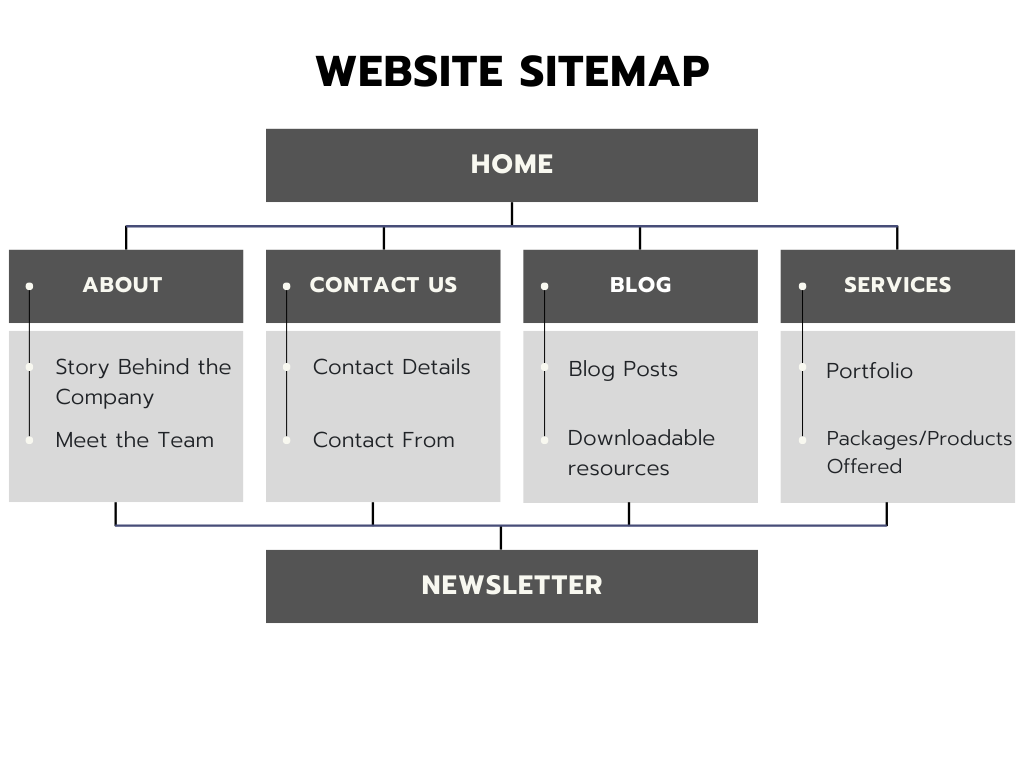
Create a sitemap – In order to visualize how all your pages are going to be interconnected and find any gaps, create a sitemap. In my opinion, a bubble chart is the simplest way to do this. It makes it easier to map out the way everything will be connected and what page leads to what. Your sitemap can be as simple or as complex and detailed as you want it. See image for an example of a simple sitemap:
Sketch a wireframe – Create a wireframe that will function as your blueprint. The truth is, I like to keep this step as simple as possible. Instead of using a digital design platform, I tend to stick to white sheets of paper and a sharpie. Doing it this way has helped me focus more on actually communicating my idea rather than wasting too much time on creating an aesthetic design that will probably end up changing quite a bit.
Choose a website platform – I think this was probably the most challenging part for me because there are SO many options (Wix, Squarespace, Format, Pixieset, etc.) and it’s a long-term commitment you’re making, so I did not take it lightly. No one wants to put in all the effort into creating a visually aesthetic website to then realize that the platform you chose doesn’t support a key feature you absolutely need. Or maybe the platform you chose does have every feature you need, but you feel like the user experience is much too complicated when it comes to the designing. You’ll quickly realize you’re spending more time trying to figure out how to do something than actually designing the website. Do your research! Not every website platform works for everyone, so find the one that works best for YOU and your business because you’ll be spending a lot of time working on it.
Plan your branding – Branding is what differentiates you from your competitors. Focus on selecting colors, fonts, and a visual style that reflect the image you want to portray of yourself and that align best with your business. Make yourself memorable!
Define your SEO strategy – Strategic content wins clients! When creating your content make sure that you are crafting clear and compelling messages using SEO tactics that will drive organic traffic to your website. SEO isn’t just about stuffing keywords here and there; it’s about actually providing valuable content that will rank well and actively keep your audience engaged.
In Conclusion
Building my website has definitely been about trial and error. I don’t believe a website is ever truly “done.” I find myself constantly revising and looking for ways to improve the look, the content, and the user experience, etc of this website. I know I will continue to add to it and remove from it as I continue my journey, so I’m glad I did my research and chose a website platform that works so well for me. As you build your website make sure to focus on clarity, credibility, and continuous improvement!